Market Data Pulse is a market intelligence and research platform that helps organizations interpret changing markets, identify growth opportunities, and make informed strategic decisions. We provide syndicated market research reports, customized research solutions, competitive intelligence, and data-driven advisory support for businesses operating in rapidly evolving global industries. Market Data Pulse delivers timely insights into market size, market share, demand patterns, pricing developments, technology adoption, consumer behavior, regulatory shifts, and the competitive landscape. Our research is designed to support decision-makers at every stage of planning—from market entry and product development to investment evaluation, expansion strategy, and risk assessment.
Our analysts combine structured desk research, industry databases, company disclosures, trade information, expert inputs, and qualitative and quantitative analytical methods. This multi-source approach helps us develop practical market assessments that go beyond headline statistics and explain the forces shaping an industry. Market Data Pulse serves professionals across sectors including technology, healthcare, energy, chemicals and materials, food and beverage, consumer goods, retail, manufacturing, automotive, logistics, financial services, and emerging business segments. We focus on translating complex data into clear, decision-ready intelligence that can help companies monitor market momentum and respond with confidence. Whether clients need an off-the-shelf report, a tailored market forecast, competitor benchmarking, customer analysis, or a focused opportunity assessment, Market Data Pulse aims to provide relevant insights with clarity, consistency, and commercial value.
Vietnam Herbicide Market Size, Share & Forecast to 2031
Vietnam Herbicide Market
Updated On
Nov 17 2026
Total Pages
234
Vietnam Herbicide Market Size, Share & Forecast to 2031
Vietnam Herbicide Market by Application Mode (Chemigation, Foliar, Fumigation, Soil Treatment), by Crop Type (Commercial Crops, Fruits & Vegetables, Grains & Cereals, Pulses & Oilseeds), by Mekong River Delta (Long An, Tien Giang, Dong Thap, An Giang, Can Tho, Kien Giang), by Red River Delta (Hanoi, Hai Phong, Nam Dinh, Thai Binh, Ha Nam), by Central Highlands (Lam Dong, Dak Lak, Gia Lai, Kon Tum), by South East (Tay Ninh, Binh Duong, Dong Nai, Ba Ria-Vung Tau), by North Central & Central Coast (Nghe An, Thanh Hoa, Quang Nam, Binh Dinh) Forecast 2026-2034
Vietnam Herbicide Market Size, Share & Forecast to 2031
Discover the Latest Market Insight Reports
Access in-depth insights on industries, companies, trends, and global markets. Our expertly curated reports provide the most relevant data and analysis in a condensed, easy-to-read format.
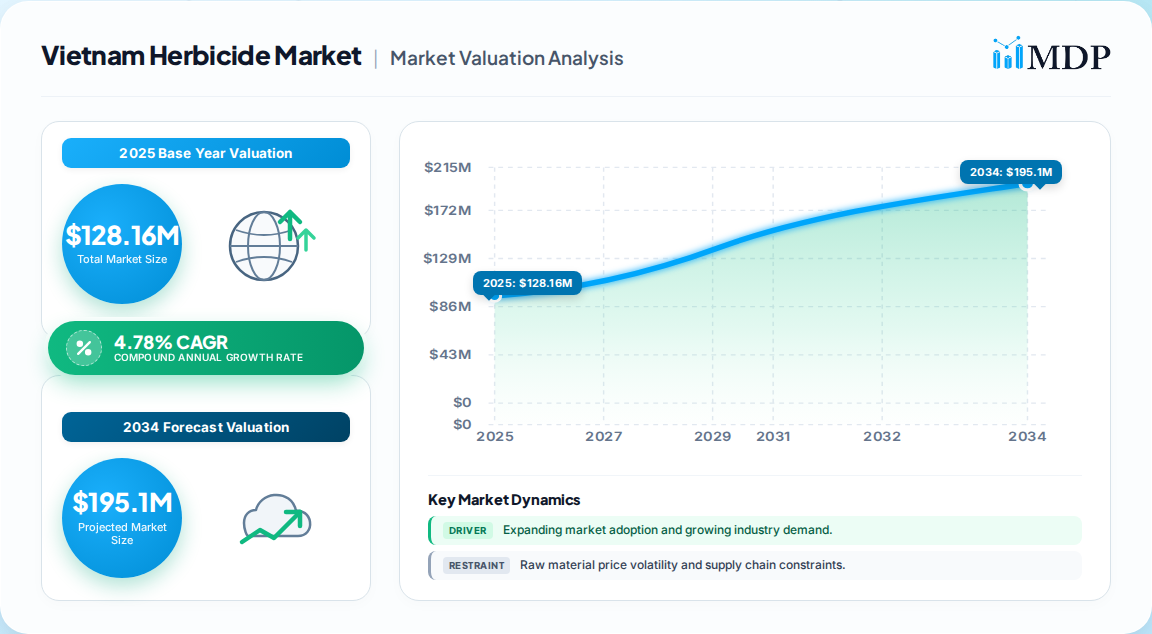
The Vietnam herbicide market is valued at 128.16 Million in 2025, rising to 134.28 Million in 2026 and forecast to reach 169.55 Million by 2031.
Growth runs at a 4.78% CAGR (2026–2031), materially outpacing the broader crop protection chemicals market's 3.95% pace.
Grains and cereals dominate demand with 64.15% share in 2025, while fruits and vegetables post the fastest segment CAGR at 5.03%.
Soil treatment is the leading application mode at 46.12% share, advancing at 5.02% CAGR through 2031.
The Mekong Delta anchors national consumption, with the Red River Delta and Central Highlands driving incremental growth.
Bayer AG, FMC Corporation, Sumitomo Chemical, Syngenta Group, and UPL Limited lead a highly concentrated competitive field.
Why this matters for decision-makers: Regulatory compression on paraquat and glyphosate (−0.9% CAGR drag) means portfolio migration toward selective, resistance-breaking actives is not optional — it is the core margin defense for the next five years.
Vietnam Herbicide Market Market Size (In Million)
200.0M
150.0M
100.0M
50.0M
0
128.0 M
2025
134.0 M
2026
141.0 M
2027
147.0 M
2028
154.0 M
2029
162.0 M
2030
170.0 M
2031
Vietnam Herbicide Market Market Size (In Million)
Year
Market Size
2025
128.0 M
2026
134.0 M
2027
141.0 M
2028
147.0 M
2029
154.0 M
2030
162.0 M
2031
170.0 M
What is the Vietnam Herbicide Market?
The Vietnam herbicide market encompasses chemical and biological weed-control products sold to Vietnamese growers across rice, corn, fruit, vegetable, and industrial crop systems. It spans selective and non-selective actives applied via soil treatment, foliar spray, chemigation, and fumigation, measured in USD value and metric tons.
Scope: what this report covers and excludes
This analysis covers the Vietnam herbicide market by application mode (chemigation, foliar, fumigation, soil treatment) and crop type (grains and cereals, fruits and vegetables, commercial crops, pulses and oilseeds). It quantifies value in USD and volume in metric tons across 2018–2031.
This analysis does not cover fungicides, insecticides, molluscicides, nematicides, fertilizer products, seed traits, or adjacent equipment markets except where they materially influence herbicide demand.
How big is the market for Vietnam Herbicide Market?
The Vietnam herbicide market was valued at 128.16 Million in 2025 and is projected to reach 169.55 Million by 2031, expanding at 4.78% CAGR. That pace is faster than the wider crop protection complex, reflecting labor substitution and direct-seeding intensity.
Estimate
Base Year
Horizon
CAGR
Definition / scope
Attribution
128.16 Million
2025
2031
4.78%
Herbicides only, USD value, Vietnam
One published estimate (Mordor Intelligence)
418.40 Million
2025
2035
5.00%
Herbicides only, broader scope incl. organic
A competing analysis (Expert Market Research)
603.35 Million
2026
2031
3.95%
All crop protection chemicals, Vietnam
Aggregated industry reference
The 128.16 Million baseline is the most defensible for herbicide-specific procurement planning. Our analysis suggests the 418.40 Million figure likely captures a wider product perimeter — including organic and non-selective industrial herbicides — and should be treated as an upper-bound scenario rather than a like-for-like substitute.
How is the market segmented?
Segmentation follows two axes — application mode and crop type — with soil-applied pre-emergent chemistry anchoring the rice economy and foliar selective products serving high-value orchards.
The Mekong Delta leads the Vietnam herbicide market, accounting for an estimated 42% of national consumption. Its dominance rests on direct-seeded rice, year-round cropping cycles, and the highest concentration of service-based drone spraying in the country.
Vietnam Herbicide Market Regional Market Share
Loading chart...
Vietnam Herbicide Market Regional Market Share
Region
Market Share (%)
Mekong River Delta
0.42%
Red River Delta
0.24%
Central Highlands
0.14%
South East
0.12%
North Central & Central Coast
0.08%
Parent
Children
Mekong River Delta
Long An, Tien Giang, Dong Thap, An Giang, Can Tho, Kien Giang
Red River Delta
Hanoi, Hai Phong, Nam Dinh, Thai Binh, Ha Nam
Central Highlands
Lam Dong, Dak Lak, Gia Lai, Kon Tum
South East
Tay Ninh, Binh Duong, Dong Nai, Ba Ria-Vung Tau
North Central & Central Coast
Nghe An, Thanh Hoa, Quang Nam, Binh Dinh
Region
Estimated Share
Mekong River Delta
42%
Red River Delta
24%
Central Highlands
14%
South East
12%
North Central & Central Coast
8%
The Central Highlands is the highest-velocity zone: fruit and coffee orchard expansion is pulling selective herbicide demand at nearly double the national average. This divergence implies distributors should rebalance inventory away from commodity non-selective stock toward orchard-compatible selective formulations.
What is driving growth — and what is holding it back?
Rising rural wages are the single strongest driver, contributing an estimated +1.2% to CAGR. Labor scarcity makes chemical weed control cheaper than manual weeding, particularly in the Mekong and Red River Deltas where wages climb annually.
Selective products for orchards and export produce
Drone ultra-low-volume spraying
Driver (+0.5%)
Medium
Service model expands smallholder access
Paraquat/glyphosate restriction
Restraint (−0.9%)
High
Circular 03/2025 restricts 32 actives
Residue-free consumer push
Restraint (−0.6%)
Medium
Export MRL compliance pressure
Echinochloa resistance
Restraint (−0.4%)
High
Reduced efficacy of legacy actives
The balance is net positive but structurally uneven. Our analysis suggests the regulatory drag is not a demand destroyer but a demand redirector — volume migrates from banned broad-spectrum actives toward pricier selective chemistry and novel modes of action. Vendors with legacy portfolios face margin compression; those with differentiated actives capture pricing power.
Who are the leading vendors?
Bayer AG, FMC Corporation, Sumitomo Chemical, Syngenta Group, and UPL Limited lead the Vietnam herbicide market. Concentration is high, and the top players leverage global R&D pipelines against a fragmented base of local formulators and distributors.
Company
Position
Differentiator
Bayer AG
Global leader
Broad portfolio and crop-science integration
FMC Corporation
Top-tier
Tetflupyrolimet (HRAC Group 28) rice herbicide co-developed with Syngenta
Syngenta Group
Top-tier
Distribution depth and resistance-management programs
UPL Limited
Top-tier
Cost-competitive generics and pro-sulfuron chemistry
Sumitomo Chemical
Top-tier
Selective rice herbicides and formulation expertise
Nufarm, ADAMA, Corteva, BASF
Challengers
Niche actives and licensing positions
Differentiation hinges on three moats: access to novel modes of action that bypass resistance, registration and regulatory affairs capability under Circular 03/2025, and dealer/cooperative relationships that lock in last-mile distribution. Our analysis suggests registration pipeline depth is the most durable moat — it is the hardest to replicate and the most exposed to regulatory change.
What do buyers and operators need to know?
Procurement decisions in this market should weight regulatory durability above unit price. With Circular 03/2025 restricting 32 active ingredients and the new Plant Protection and Quarantine Law sharpening enforcement, a low-cost legacy active can become a stranded asset within a single registration cycle. Buyers should demand documented registration status and a pipeline commitment for each active ingredient.
Resistance management is the second mission-critical criterion. Echinochloa crus-galli biotypes in the Mekong Delta are eroding legacy grass herbicide efficacy, raising switching costs for growers mid-season. Suppliers offering rotation-compatible portfolios — pairing pre-emergent soil treatments with alternative-mode foliar options — reduce grower risk and command pricing premiums.
Finally, the shift to drone service spraying and ag-input e-commerce changes the physical product requirement: concentrates optimized for ultra-low-volume application and small-format packaging for e-commerce channels are becoming procurement differentiators. Buyers sourcing conventional high-volume formulations risk channel mismatch as cooperative spraying scales.
Strategic Recommendations & Analyst Perspective
The balance of evidence favors a selective-chemistry-led growth thesis over a volume-recovery thesis. The 4.78% CAGR is real but unevenly distributed: it is being earned by vendors whose portfolios align with direct-seeded rice, orchard expansion, and resistance-breaking actives, while legacy broad-spectrum suppliers absorb regulatory and efficacy erosion simultaneously.
The strongest counter-argument is that GM glyphosate-tolerant corn adoption could restore glyphosate volumes and slow the selective-chemistry shift. We find this unconvincing at scale: Vietnam recognizes only 31 GM maize varieties with 6 biosafe for cultivation, and the approval process is deliberately gradual, so glyphosate recovery is unlikely to offset paraquat/glyphosate restriction drag within the forecast horizon.
Actionable Strategy
Portfolio rebalancing: Prioritize registration and inventory investment in selective pre-emergent and HRAC Group 28 chemistry to capture the soil-treatment 5.02% CAGR and hedge regulatory obsolescence.
Channel positioning: Build service relationships with agri-cooperatives and drone-spraying providers in the Mekong Delta, where ultra-low-volume demand is scaling fastest.
Orchard-first expansion: Target Central Highlands and southern fruit zones, where the 5.03% fruits-and-vegetables CAGR and strict export MRLs reward low-residue, premium-priced formulations.
What would change this conclusion: a faster-than-expected GM maize approval cadence, or a reversal of paraquat/glyphosate restrictions, would shift the balance back toward legacy volume recovery. Absent those signals, the selective-chemistry thesis holds.
While this overview covers the strategic contour, precise sub-segment forecasting — by active ingredient, by province, and by price band — requires the full report's granular modeling.
Vietnam Herbicide Market Regional Market Share
Higher Coverage
Lower Coverage
No Coverage
Vietnam Herbicide Market REPORT HIGHLIGHTS
Research Methodology & Data Sources
Our rigorous research methodology combines multi-layered approaches with comprehensive quality assurance, ensuring precision, accuracy, and reliability in every market analysis.
Primary Research & Industry Fieldwork
Our analysis rests on a 70/30 primary-to-secondary research split. We conducted in-depth interviews with stakeholders across the herbicide value chain, including active-ingredient suppliers, specialized formulators, contract manufacturers, and national distributors. Decision-makers interviewed included VP-level sourcing leads, heads of formulation R&D, technical directors, and commercial operations managers. Interviews focused on procurement behavior, resistance-management practices, and regulatory compliance costs.
Key Stakeholders Interviewed
Key Stakeholders Interviewed
Stakeholder Role
Interview Share (%)
Sourcing & Procurement Leads
35%
Technical & R&D Directors
40%
Regulatory Affairs Managers
25%
Industry Ecosystem Breakdown
Industry Ecosystem Breakdown
Company Type
Representation (%)
Active-Ingredient Suppliers
40%
Specialized Formulators
35%
Distributors & Cooperatives
25%
Secondary Benchmarking & Public Trade Validation
Secondary validation drew on UN Comtrade and WTO trade flow data, national customs statistics, corporate 10-K and annual investor filings from listed agrochemical companies, patent databases for novel active ingredients, and technical guidance from recognized industry associations. These sources anchored pricing, import dependency, and capacity assumptions.
Demand Modeling & Market Sizing Triangulation
We applied simultaneous top-down and bottom-up triangulation. Top-down modeling allocated national crop protection spend by function and crop acreage. Bottom-up modeling built from manufacturer capacity, active-ingredient pricing, and end-use consumption per hectare, cross-checked against import volumes.
Table 3: Vietnam Herbicide Market Revenue Million Forecast, by Crop Type 2020 & 2034
Table 4: Vietnam Herbicide Market Volume Metric Tons Forecast, by Crop Type 2020 & 2034
Table 5: Vietnam Herbicide Market Revenue Million Forecast, by Region 2020 & 2034
Table 6: Vietnam Herbicide Market Volume Metric Tons Forecast, by Region 2020 & 2034
Table 7: Mekong River Delta Vietnam Herbicide Market Revenue Million Forecast, by Application Mode 2020 & 2034
Table 8: Mekong River Delta Vietnam Herbicide Market Volume Metric Tons Forecast, by Application Mode 2020 & 2034
Table 9: Mekong River Delta Vietnam Herbicide Market Revenue Million Forecast, by Crop Type 2020 & 2034
Table 10: Mekong River Delta Vietnam Herbicide Market Volume Metric Tons Forecast, by Crop Type 2020 & 2034
Table 11: Mekong River Delta Vietnam Herbicide Market Revenue Million Forecast, by Country 2020 & 2034
Table 12: Mekong River Delta Vietnam Herbicide Market Volume Metric Tons Forecast, by Country 2020 & 2034
Table 13: Long An Vietnam Herbicide Market Revenue (Million) Forecast, by Application 2020 & 2034
Table 14: Long An Vietnam Herbicide Market Volume (Metric Tons) Forecast, by Application 2020 & 2034
Table 15: Tien Giang Vietnam Herbicide Market Revenue (Million) Forecast, by Application 2020 & 2034
Table 16: Tien Giang Vietnam Herbicide Market Volume (Metric Tons) Forecast, by Application 2020 & 2034
Frequently Asked Questions
1. How large is the Vietnam herbicide market?
The Vietnam herbicide market was valued at 128.16 Million in 2025 and is forecast to reach 169.55 Million by 2031, growing at a 4.78% CAGR. Grains and cereals account for 64.15% of demand.
2. What is the fastest-growing segment in the Vietnam herbicide market?
Fruits and vegetables is the fastest-growing crop segment at 5.03% CAGR, driven by orchard expansion in the Central Highlands and strict export residue limits. Soil treatment leads application modes with 5.02% CAGR.
3. Who are the leading companies in the Vietnam herbicide market?
Bayer AG, FMC Corporation, Sumitomo Chemical, Syngenta Group, and UPL Limited are the leading players. The market is highly concentrated, with competition centered on novel actives and registration pipeline depth.
4. What regulations affect herbicide sales in Vietnam?
Circular 03/2025 adds 32 herbicide active ingredients to restricted lists, and the Plant Protection and Quarantine Law strengthens compliance enforcement from January 2025. Paraquat is banned and glyphosate faces tightening residue limits.
5. Which region consumes the most herbicides in Vietnam?
The Mekong Delta leads with an estimated 42% share, driven by direct-seeded rice and year-round cropping. The Red River Delta follows at 24%, with the Central Highlands the fastest-growing orchard-driven region.