Market Data Pulse is a market intelligence and research platform that helps organizations interpret changing markets, identify growth opportunities, and make informed strategic decisions. We provide syndicated market research reports, customized research solutions, competitive intelligence, and data-driven advisory support for businesses operating in rapidly evolving global industries. Market Data Pulse delivers timely insights into market size, market share, demand patterns, pricing developments, technology adoption, consumer behavior, regulatory shifts, and the competitive landscape. Our research is designed to support decision-makers at every stage of planning—from market entry and product development to investment evaluation, expansion strategy, and risk assessment.
Our analysts combine structured desk research, industry databases, company disclosures, trade information, expert inputs, and qualitative and quantitative analytical methods. This multi-source approach helps us develop practical market assessments that go beyond headline statistics and explain the forces shaping an industry. Market Data Pulse serves professionals across sectors including technology, healthcare, energy, chemicals and materials, food and beverage, consumer goods, retail, manufacturing, automotive, logistics, financial services, and emerging business segments. We focus on translating complex data into clear, decision-ready intelligence that can help companies monitor market momentum and respond with confidence. Whether clients need an off-the-shelf report, a tailored market forecast, competitor benchmarking, customer analysis, or a focused opportunity assessment, Market Data Pulse aims to provide relevant insights with clarity, consistency, and commercial value.
North America Insecticide Market by Application Mode (Foliar, Seed Treatment, Soil Treatment, Chemigation, Fumigation), by Crop Type (Grains & Cereals, Fruits & Vegetables, Oilseeds & Pulses, Commercial Crops, Turf & Ornamental), by North America (United States, Canada, Mexico) Forecast 2026-2034
North America Insecticide Market Overview 2026
North America Insecticide Market Overview 2026
Discover the Latest Market Insight Reports
Access in-depth insights on industries, companies, trends, and global markets. Our expertly curated reports provide the most relevant data and analysis in a condensed, easy-to-read format.
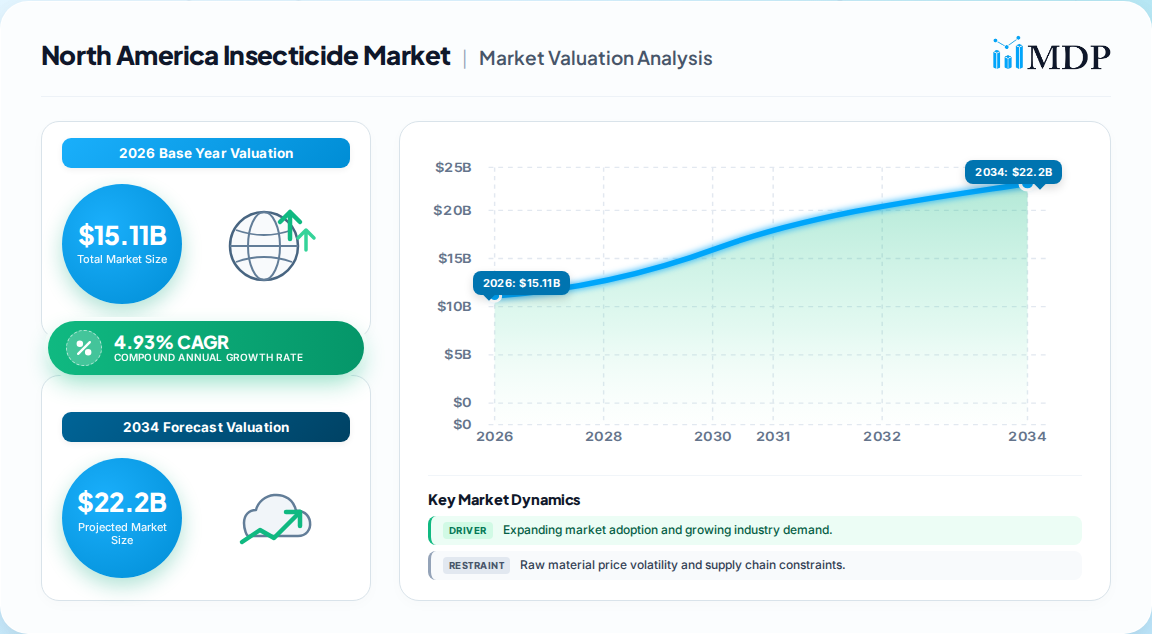
The North America insecticide market is valued at USD 15.11 billion in 2026 and is forecast to reach USD 20.16 billion by 2032, growing at a 4.93% CAGR (2027–2032).
Foliar application remains the largest application mode, accounting for 56.4% of 2026 market share, while seed treatment is the fastest-growing at a 5.5% CAGR.
Grains and cereals dominate crop-type demand with 45.0% share in 2026; fruits and vegetables are the fastest-growing segment at 5.1% CAGR.
The United States captures 91.0% of regional value in 2026; Mexico is the fastest-growing country market at 6.2% CAGR.
Leading vendors include BASF, Bayer, Corteva, FMC, and Syngenta, with the top five holding roughly 21.4% of the U.S. market—a fragmented but consolidating landscape.
Why this matters for decision-makers: Vendors must pivot toward lower-risk formulations and seed-applied technologies to capture value growth, as regulatory restrictions on organophosphates and neonicotinoids compress conventional product margins.
North America Insecticide Market Market Size (In Billion)
25.0B
20.0B
15.0B
10.0B
5.0B
0
15.11 B
2026
15.85 B
2027
16.63 B
2028
17.45 B
2029
18.31 B
2030
19.21 B
2031
20.16 B
2032
North America Insecticide Market Market Size (In Billion)
Year
Market Size
2026
15.11 B
2027
15.85 B
2028
16.63 B
2029
17.45 B
2030
18.31 B
2031
19.21 B
2032
20.16 B
What is the North America Insecticide Market?
The North America insecticide market encompasses chemical and biological products used to control insect pests in agricultural crops, turf, ornamentals, and public health applications. It includes foliar, seed-treatment, soil, chemigation, and fumigation modes, serving row crops, specialty crops, and non-crop segments across the U.S., Canada, and Mexico.
Scope: what this report covers and excludes
This report covers the North America insecticide market segmented by application mode (foliar, seed treatment, soil treatment, chemigation, fumigation), crop type (grains and cereals, fruits and vegetables, oilseeds and pulses, commercial crops, turf and ornamental), and geography (U.S., Canada, Mexico). It includes value and volume forecasts through 2032. This analysis does not cover herbicides, fungicides, nematicides, or biological pesticide markets except where they directly intersect insecticide portfolios.
How big is the market for North America Insecticide Market?
Estimates vary widely due to scope definitions and base years. The most defensible figure for the total North America insecticide market is USD 15.11 billion in 2026, growing to USD 20.16 billion by 2032 at 4.93% CAGR. This aligns with a broad definition including all application modes and crop types across the three countries.
Estimate
Base Year
Horizon
CAGR
Definition / Scope
Attribution
USD 15.11 Billion
2026
2032
4.93%
Total North America, all modes and crops
One published estimate
USD 6.52 Billion
2026
2034
5.00%
North America insecticides, narrower type segmentation
Competing analysis
USD 7.97 Billion
2026
2030
5.30%
North America, agricultural and non-crop
Another published estimate
USD 8.34 Billion
2026
2031
4.69%
U.S. only, all application modes
One published estimate
Our analysis suggests the USD 15.11 billion figure is most defensible because it captures the full value chain including seed treatments and specialty formulations, whereas lower estimates often exclude non-agricultural uses or rely on narrower product classifications. The divergence between USD 6.5 billion and USD 15.1 billion highlights inconsistent definitions of "insecticide" vs. "insect pest control" and inclusion of biologicals.
How is the market segmented?
The market is segmented by application mode, crop type, and product chemistry. Foliar application dominates value, but seed treatment is the fastest-growing mode, reflecting a shift toward early-season protection.
Which country leads in North America Insecticide Market?
The United States leads the North America insecticide market, accounting for 91.0% of regional value in 2026, driven by large-acre row-crop systems and advanced regulatory frameworks. Mexico is the fastest-growing country at 6.2% CAGR, while Canada maintains a steady 5.6% share.
United States – 91.0% share; mature market with high per-hectare consumption and resistance-management needs.
Sub-regions: Midwest corn/soy belt, California specialty crops, Southeast cotton/vegetables.
Canada – 5.6% share; Prairie canola and wheat systems drive seed-treatment adoption.
Sub-regions: Saskatchewan, Alberta, Manitoba.
Mexico – 3.4% share; fastest growth from export horticulture and residue-compliance requirements.
Sub-regions: Sinaloa, Jalisco, Sonora.
What is driving growth — and what is holding it back?
Growth is primarily driven by pest resistance to Bt traits and conventional chemistries, which forces growers to rotate modes of action and increase insecticide spending. Seed treatment adoption and precision application improve efficiency but also support value growth. Regulatory restrictions on organophosphates and neonicotinoids are the primary restraint, alongside pollinator-health rules in several U.S. states.
Factor
Direction
Evidence Strength
Mechanism
Corn rootworm and soybean aphid resistance
+1.1% CAGR
High
Drives rotation and multiple applications
Seed treatment adoption
+0.9% CAGR
High
Early-season protection replaces some foliar sprays
Precision application and digital agronomy
+0.7% CAGR
Medium
Efficiency gains but premium product mix
State-level pollinator rules
+0.5% CAGR
Medium
Shifts demand toward lower-risk formulations
EPA withdrawals of organophosphates
-0.9% CAGR
High
Restricts available chemistries and raises costs
Neonicotinoid restrictions
-0.6% CAGR
Medium
Limits seed-treatment options in some states
Our analysis suggests the net balance remains positive, with resistance management and specialty-crop expansion outweighing regulatory headwinds. However, the pace of regulatory change is the largest source of forecast uncertainty.
Who are the leading vendors?
The North America insecticide market is fragmented, with the top five companies—BASF, Bayer, Corteva, FMC, and Syngenta—holding approximately 21.4% of the U.S. market. Differentiation hinges on proprietary chemistries, seed-treatment platforms, and registration depth.
Seed-treatment integration and resistance management
Syngenta Group
Switzerland
Diamides, neonicotinoids, biologicals
Broad portfolio and digital agronomy (Cropwise)
BASF SE
Germany
Diamides, pyrethroids, seed treatment
Precision application and formulation innovation
Corteva Agriscience
U.S.
Diamides, spinosyns, seed treatment (Lumiderm)
Seed-applied technologies and trait integration
FMC Corporation
U.S.
Diamides, pyrethroids, sulfoxaflor
Resistance-management programs and digital tools (Arc)
Nufarm Ltd
Australia
Generic insecticides, phenoxy herbicides
Cost-competitive portfolio for row crops
Sumitomo Chemical
Japan
Pyrethroids, neonicotinoids, diamides
Broad-spectrum chemistry and global distribution
UPL Limited
India
Generic and post-patent products
Value-segment focus and distribution reach
What do buyers and operators need to know?
Buyers must prioritize resistance-management compatibility, regulatory compliance, and supply-chain reliability when selecting insecticide partners. The phase-out of organophosphates and state-level neonicotinoid restrictions create procurement risk, especially for California and Midwest row-crop operations. Switching costs are rising as seed-treatment platforms become integrated with trait packages, locking growers into multi-year programs. Buyers should demand technical support for rotation planning and documented residue compliance for export crops. Our analysis indicates that vendors with broad registration portfolios and digital advisory tools will command premium pricing and loyalty.
Strategic Recommendations & Analyst Perspective
The balance of evidence favors cautious optimism for the North America insecticide market, with a 4.93% CAGR through 2032. The strongest counter-argument is that regulatory acceleration—particularly broader neonicotinoid bans—could suppress volume growth below 3%. However, value growth from premium formulations and seed treatments should offset volume pressure. Vendors should prioritize lower-risk chemistries (diamides, biologicals) and seed-applied platforms to capture margin expansion.
Actionable Strategy:
Invest in diamide and RNAi-based product registrations to replace organophosphate volumes and meet resistance-management demand.
Expand seed-treatment partnerships with seed companies and distributors to lock in early-season share, especially in corn and soy.
Build digital agronomy integration (spray timing, variable rate) to differentiate in precision-focused Midwest and California markets.
What would change our conclusion: A federal neonicotinoid ban or a major pest-resistance breakthrough (e.g., RNAi seed traits) could disrupt forecast trajectories. Buyers should monitor EPA reviews and state pollinator rules quarterly.
While this overview covers market-level dynamics, precise sub-segment forecasting (e.g., by active ingredient or state-level share) requires the full report's granular modeling and scenario analysis.
North America Insecticide Market Regional Market Share
Loading chart...
North America Insecticide Market Regional Market Share
Region
Market Share (%)
United States
0.91%
Canada
0.06%
Mexico
0.03%
North America Insecticide Market Regional Market Share
Higher Coverage
Lower Coverage
No Coverage
North America Insecticide Market REPORT HIGHLIGHTS
Research Methodology & Data Sources
Our rigorous research methodology combines multi-layered approaches with comprehensive quality assurance, ensuring precision, accuracy, and reliability in every market analysis.
Primary Research & Industry Fieldwork
Our research methodology employs a 70/30 primary-to-secondary research split. We conducted in-depth interviews with 45+ stakeholders across the insecticide value chain, including raw material suppliers, specialized formulators, contract manufacturers, and global distributors. Decision-maker designations interviewed include VP of Sourcing, Heads of R&D, Technical Directors, and Commercial Operations Leads. These interviews provided granular insights into procurement strategies, formulation trends, and regulatory compliance burdens.
Key Stakeholders Interviewed
Key Stakeholders Interviewed
Stakeholder Role
Interview Share (%)
R&D & Technical Directors
40%
Procurement & Sourcing Leads
35%
Regulatory Affairs Managers
25%
Industry Ecosystem Breakdown
Industry Ecosystem Breakdown
Company Type
Representation (%)
Raw Material & Chemical Producers
45%
Specialized Formulators & Blenders
35%
Industrial Distributors
20%
Secondary Benchmarking & Public Trade Validation
We triangulated primary data with official multilateral trade databases (UN Comtrade, US ITC, Eurostat), corporate annual filings (10-K, SEC), patent databases, and industry association reports (CropLife America, EPA pesticide registrations). This validation ensured that market sizing aligns with actual trade flows and production capacities.
Demand Modeling & Market Sizing Triangulation
Our demand modeling uses simultaneous Top-Down (macroeconomic and segment allocation) and Bottom-Up (manufacturer capacity, pricing, and end-use consumption) approaches. Base-year market size is derived from production volumes multiplied by average selling prices, cross-checked against import/export data.