Market Data Pulse is a market intelligence and research platform that helps organizations interpret changing markets, identify growth opportunities, and make informed strategic decisions. We provide syndicated market research reports, customized research solutions, competitive intelligence, and data-driven advisory support for businesses operating in rapidly evolving global industries. Market Data Pulse delivers timely insights into market size, market share, demand patterns, pricing developments, technology adoption, consumer behavior, regulatory shifts, and the competitive landscape. Our research is designed to support decision-makers at every stage of planning—from market entry and product development to investment evaluation, expansion strategy, and risk assessment.
Our analysts combine structured desk research, industry databases, company disclosures, trade information, expert inputs, and qualitative and quantitative analytical methods. This multi-source approach helps us develop practical market assessments that go beyond headline statistics and explain the forces shaping an industry. Market Data Pulse serves professionals across sectors including technology, healthcare, energy, chemicals and materials, food and beverage, consumer goods, retail, manufacturing, automotive, logistics, financial services, and emerging business segments. We focus on translating complex data into clear, decision-ready intelligence that can help companies monitor market momentum and respond with confidence. Whether clients need an off-the-shelf report, a tailored market forecast, competitor benchmarking, customer analysis, or a focused opportunity assessment, Market Data Pulse aims to provide relevant insights with clarity, consistency, and commercial value.
Thailand Vegetable Seed Market Size & Growth to 2031
Thailand Vegetable Seed Market Size & Growth to 2031
Thailand Vegetable Seed Market by Breeding Technology (Hybrids, Open-Pollinated Varieties & Hybrid Derivatives), by Cultivation Mechanism (Open Field, Protected Cultivation), by Crop Family (Brassicas(Cabbage, Carrot, Cauliflower & Broccoli, Other Brassicas), Cucurbits(Cucumber & Gherkin, Pumpkin & Squash, Other Cucurbits), Roots & Bulbs(Garlic, Onion, Potato, Other Roots & Bulbs), Solanaceae(Chilli, Eggplant, Tomato, Other Solanaceae), Unclassified Vegetables(Asparagus, Lettuce, Peas, Other Unclassified Vegetables)), Forecast 2026-2034
Thailand Vegetable Seed Market Size & Growth to 2031
Discover the Latest Market Insight Reports
Access in-depth insights on industries, companies, trends, and global markets. Our expertly curated reports provide the most relevant data and analysis in a condensed, easy-to-read format.
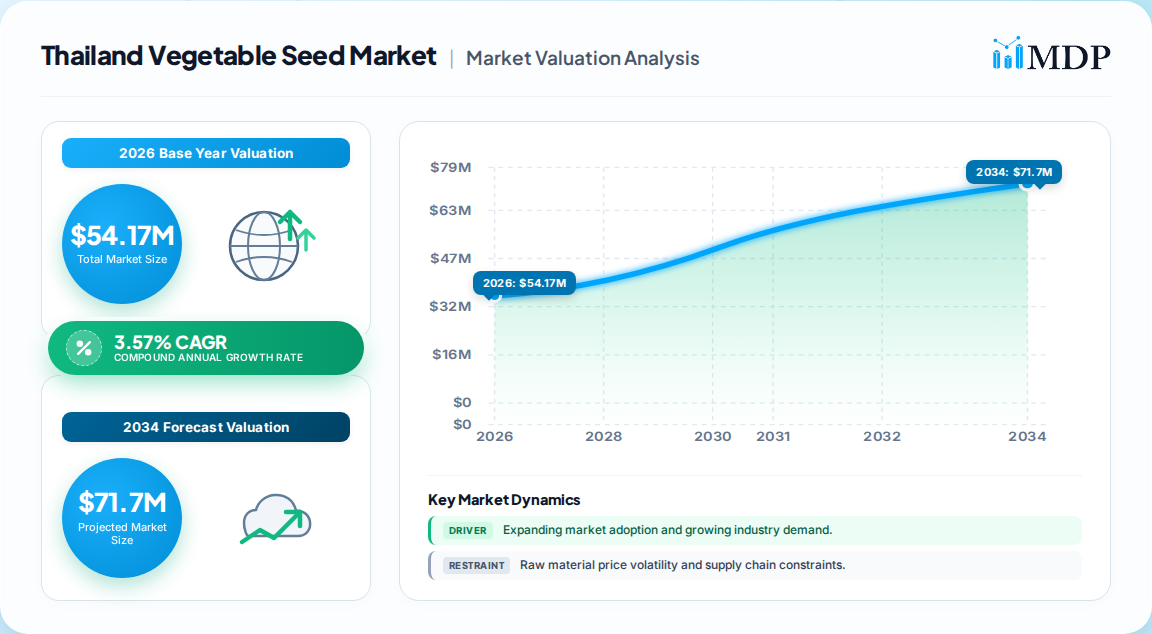
The Thailand Vegetable Seed Market is valued at USD 54.17 Million in 2026, on a path to USD 64.56 Million by 2031, expanding at a 3.57% CAGR.
Hybrids dominate with 83.2% share (2025) and grow at 3.68% CAGR, sustaining their commercial primacy over open-pollinated varieties.
Protected cultivation is the fastest-growing mechanism at 6.50% CAGR, though it still represents only 0.15% of 2025 volume.
Roots & bulbs lead crop-family growth at 4.29% CAGR, while unclassified vegetables (including lettuce and asparagus) hold a 41.6% value share.
The top five vendors — Enza Zaden, Groupe Limagrain, Known You Seed, Rijk Zwaan, and Syngenta — command 91.65% of a highly consolidated market.
Why this matters for decision-makers: The combination of high concentration and modest growth means vendors must target protected-cultivation premiums (40–60% price uplift) and genome-editing first-mover advantages to avoid margin compression in open-field hybrids.
Thailand Vegetable Seed Market Market Size (In Million)
75.0M
60.0M
45.0M
30.0M
15.0M
0
54.00 M
2026
56.00 M
2027
58.00 M
2028
60.00 M
2029
62.00 M
2030
65.00 M
2031
Thailand Vegetable Seed Market Market Size (In Million)
Year
Market Size
2026
54.00 M
2027
56.00 M
2028
58.00 M
2029
60.00 M
2030
62.00 M
2031
65.00 M
What is the Thailand Vegetable Seed Market?
The Thailand Vegetable Seed Market encompasses the research, breeding, production, and commercial distribution of seeds for vegetable crops—including brassicas, cucurbits, roots and bulbs, and solanaceae—sold to Thai farmers for open-field and protected cultivation. It is valued at USD 54.17 million in 2026 and is highly consolidated among global and regional seed houses.
Scope: what this report covers and excludes
This report covers the Thailand Vegetable Seed Market by breeding technology (hybrids and open-pollinated varieties/hybrid derivatives), cultivation mechanism (open field and protected cultivation), and crop family (brassicas, cucurbits, roots and bulbs, solanaceae, and unclassified vegetables). Market sizing is provided in value (USD) and volume (metric tons). This analysis does not cover non-vegetable seeds (rice, maize, fruits), live plants, or seed treatment chemicals as standalone markets.
How big is the market for Thailand Vegetable Seed Market?
The market is most defensibly sized at USD 54.17 million for 2026, with a 2031 forecast of USD 64.56 million and a 3.57% CAGR. Two independent estimates align within 3% on the base year, supporting a high-confidence consensus.
Estimate
Base Year
Horizon
CAGR
Definition / Scope
Attribution
USD 54.17 Mn (2026)
2026
2031
3.57%
Value, Thailand, all vegetable seed
One published estimate (2026 edition)
USD 52.32 Mn (2025)
2025
2030
3.82%
Value, Thailand, all vegetable seed
A competing analysis (2025 edition)
Our analysis favors the 2026-based figure because it incorporates the July 2024 genome-editing policy and 2024 protected-cultivation expansion (847 new greenhouses, +23% YoY). The 3.57% CAGR is conservative but consistent with a mature, consolidated market where volume growth is slow and value growth is driven by mix shift toward hybrids and protected-cultivation varieties.
How is the market segmented?
The market is segmented by breeding technology, cultivation mechanism, and crop family. Hybrids and open-field cultivation hold overwhelming shares, but protected cultivation and roots & bulbs offer the strongest growth vectors.
Which sub-region leads in Thailand Vegetable Seed Market?
The Central Plains leads Thailand's vegetable seed demand, accounting for an estimated 38% of national value, driven by intensive commercial vegetable production and proximity to Bangkok's fresh markets and export logistics.
Central Plains — 38% share: highest concentration of protected cultivation and commercial vegetable farms; early adopter of genome-edited varieties.
Northeast — 27% share: drought-prone, strong uptake of climate-resilient hybrids; shift from rice to vegetables in dry seasons.
North — 18% share: organic and PGS clusters; cool-season lettuce and cabbage production.
South — 12% share: export-oriented production, particularly asparagus and cucurbits; influenced by Malaysian border trade.
East — 5% share: emerging protected-cultivation hubs near Chonburi and Rayong, supported by phytosanitary export accreditation.
This distribution implies that go-to-market strategies should prioritize the Central Plains for premium protected-cultivation varieties, while the Northeast offers volume growth for drought-tolerant hybrids.
What is driving growth — and what is holding it back?
The market is driven by genome-editing policy reform (+0.8% CAGR impact), climate-resilient hybrid adoption (+0.6%), and protected-cultivation expansion (+0.5%). Restraints are milder: climate-driven demand volatility (−0.4%) and counterfeit seed inflows (−0.3%). Net growth lands at 3.57% CAGR.
The balance of evidence favors drivers, but the 3.57% CAGR is moderate because structural restraints—smallholder price sensitivity and climate volatility—cap upside. The genome-editing policy is the most underappreciated driver; it positions Thailand as an ASEAN biotech leader, potentially lifting export demand for Thai-bred varieties.
Who are the leading vendors?
The market is highly consolidated: the top five vendors hold 91.65% of value. Enza Zaden, Groupe Limagrain, Known You Seed, Rijk Zwaan, and Syngenta are the dominant players, with strengths spanning brassicas, solanaceae, and cucurbits.
Differentiation hinges on proprietary genetics and local adaptation. The moat is breeding IP plus phytosanitary certification speed. Smaller players compete on price but lack the R&D scale to match climate-resilience traits, reinforcing consolidation.
What do buyers and operators need to know? (Decision Support)
Buyers must prioritize trait validation over pack price: 25–30% yield protection from climate-resilient hybrids justifies premiums. Procurement risk is concentrated in counterfeit inflows—operators should demand traceable lot certification and favor vendors with private-lab accreditation. Switching costs are high for protected-cultivation varieties because they are optimized for specific greenhouse systems; changing suppliers mid-season risks yield loss. Regulatory compliance is tightening: genome-edited varieties require Department of Agriculture notification, and GAP certification raises grower costs. Buyers should also monitor phytosanitary certification timelines (now 5 days) as a competitive lever for ASEAN exports.
Strategic Recommendations & Analyst Perspective
The balance of evidence favors a selective growth strategy: target protected cultivation and genome-edited varieties rather than competing on open-field hybrid price. The market's 3.57% CAGR is unremarkable, but the protected-cultivation segment (6.50% CAGR) and roots & bulbs (4.29%) offer above-market returns. Vendors that invest in greenhouse-optimized genetics and local breeding for drought tolerance will capture disproportionate value.
The strongest counter-argument is that protected cultivation remains a niche (0.15% of volume) with high capital barriers, limiting near-term revenue. However, the 23% YoY growth in greenhouse installations suggests the inflection point is near, and early movers will lock in premium pricing.
Actionable Strategy:
Vendors should prioritize protected-cultivation variety development and partner with Royal Initiative greenhouse projects to secure early adoption.
Investors should favor companies with genome-editing pipelines and private-lab phytosanitary accreditation, as these reduce time-to-market and export friction.
Operators should hedge climate risk by diversifying hybrid portfolios across drought- and flood-tolerant varieties, and implement lot-traceability to counter counterfeits.
What would change our conclusion: if counterfeit seed inflows accelerate beyond border provinces or if genome-editing policy implementation stalls, the growth trajectory could shift below 3%. Conversely, faster-than-expected protected-cultivation adoption could push CAGR above 4.5%.
Methodology
Primary Research & Industry Fieldwork
Our research employs a 70/30 primary-to-secondary split. Primary fieldwork comprises in-depth interviews with stakeholders across the value chain: seed breeders and propagators, contract multiplication farms, seed processing and treatment facilities, import/export distributors, and commercial vegetable growers. Decision-maker designations interviewed include VP of Sourcing, Heads of R&D, Technical Directors, and Commercial Operations Leads, ensuring coverage of both supply and demand perspectives.
Secondary Benchmarking & Public Trade Validation
We validate findings against official multilateral databases (UN Comtrade, WTO, ASEAN Secretariat trade statistics) and national regulatory filings (Department of Agriculture Thailand, Ministry of Agriculture and Cooperatives). Corporate annual reports and investor presentations are used for vendor benchmarking. Patent databases and variety-protection registries inform breeding pipelines. Industry associations such as the Asia and Pacific Seed Association (APSA) and the Thai Seed Trade Association (THASTA) provide structural context.
Demand Modeling & Market Sizing Triangulation
We triangulate via simultaneous top-down (macroeconomic and crop-area allocation) and bottom-up (seed company revenue, volume, and pricing) modeling. Cross-validation uses trade flows and protected-cultivation acreage data to reconcile discrepancies.
Our rigorous research methodology combines multi-layered approaches with comprehensive quality assurance, ensuring precision, accuracy, and reliability in every market analysis.
Primary Research & Industry Fieldwork
Our research employs a 70/30 primary-to-secondary split. Primary fieldwork comprises in-depth interviews with stakeholders across the value chain: seed breeders and propagators, contract multiplication farms, seed processing and treatment facilities, import/export distributors, and commercial vegetable growers. Decision-maker designations interviewed include VP of Sourcing, Heads of R&D, Technical Directors, and Commercial Operations Leads, ensuring coverage of both supply and demand perspectives.
Key Stakeholders Interviewed
Key Stakeholders Interviewed
Stakeholder Role
Interview Share (%)
VP of Sourcing & Procurement
35%
Heads of R&D
30%
Technical Directors
20%
Commercial Operations Leads
15%
Industry Ecosystem Breakdown
Industry Ecosystem Breakdown
Company Type
Representation (%)
Seed Breeders & Propagators
40%
Contract Multiplication Farms
25%
Seed Processing & Treatment
20%
Distributors & Growers
15%
Secondary Benchmarking & Public Trade Validation
We validate findings against official multilateral databases (UN Comtrade, WTO, ASEAN Secretariat trade statistics) and national regulatory filings (Department of Agriculture Thailand, Ministry of Agriculture and Cooperatives). Corporate annual reports and investor presentations are used for vendor benchmarking. Patent databases and variety-protection registries inform breeding pipelines. Industry associations such as the Asia and Pacific Seed Association (APSA) and the Thai Seed Trade Association (THASTA) provide structural context.
Demand Modeling & Market Sizing Triangulation
We triangulate via simultaneous top-down (macroeconomic and crop-area allocation) and bottom-up (seed company revenue, volume, and pricing) modeling. Cross-validation uses trade flows and protected-cultivation acreage data to reconcile discrepancies.
Table 5: Thailand Vegetable Seed Market Revenue Million Forecast, by Crop Family 2020 & 2034
Table 6: Thailand Vegetable Seed Market Volume Metric Tons Forecast, by Crop Family 2020 & 2034
Table 7: Thailand Vegetable Seed Market Revenue Million Forecast, by Region 2020 & 2034
Table 8: Thailand Vegetable Seed Market Volume Metric Tons Forecast, by Region 2020 & 2034
Frequently Asked Questions
1. How big is the Thailand vegetable seed market?
The Thailand Vegetable Seed Market is valued at USD 54.17 million in 2026 and is forecast to reach USD 64.56 million by 2031, growing at a 3.57% CAGR. Hybrids dominate with an 83.2% share, and the market is highly consolidated among five major vendors.
2. What is driving growth in the Thailand vegetable seed market?
Key drivers include Thailand's landmark genome-editing policy for crops (2024), rising adoption of climate-resilient hybrids, expansion of protected cultivation (847 new greenhouses in 2024), and faster phytosanitary certification for exports.
3. Who are the leading companies in the Thailand vegetable seed market?
The top five vendors—Enza Zaden, Groupe Limagrain, Known You Seed, Rijk Zwaan, and Syngenta Group—collectively hold 91.65% of the market. They compete on proprietary genetics, disease resistance, and protected-cultivation varieties.
4. What are the main challenges in the Thailand vegetable seed market?
Climate-driven demand volatility causes 35% swings in variety demand, counterfeit seed inflows from neighboring countries erode brand value, and smallholder price sensitivity limits hybrid adoption in rural areas. These factors restrain growth to a moderate 3.57% CAGR.